

Your AI agents are multiplying. Do you know where they all are?
A year ago, most engineering orgs had zero AI agents in production. Today they have dozens - a code review bot here, a customer-support agent there, an internal RAG assistant a team spun up over a hackathon weekend. Agents are shipping faster than anyone can track them.
That's the problem. Agents are software, but most orgs treat them like science experiments. Nobody owns the full list. Nobody knows which model each one calls, what data it touches, or who to page when it starts hallucinating in front of a customer. The same visibility gap that plagued microservices five years ago is back - except this time the "services" can make autonomous decisions.
The good news: you already have the tool to fix this. If you're running OpsLevel, you can model every agent in your organization as a first-class component in your catalog.
Model agents as custom components
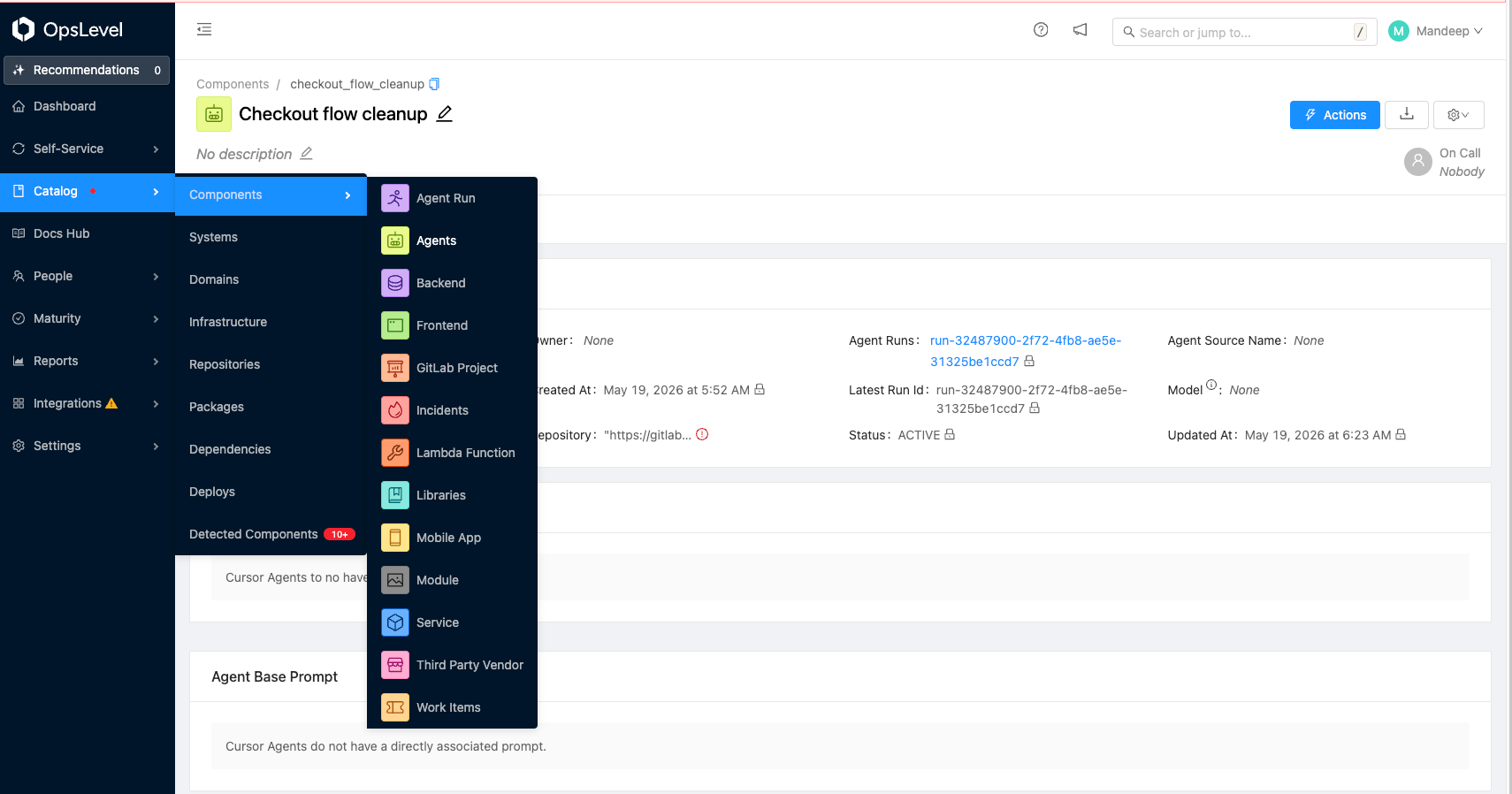
OpsLevel's catalog isn't limited to services. With custom component types, you can define exactly what an "AI Agent" is in your world and track them alongside everything else you own.
Start by creating an AI Agent component type with the properties that matter for governance:
- Model and provider - claude-opus-4-8, GPT, in-house, etc.
- Owner - the team on the hook when it misbehaves
- Purpose - what job it actually does
- Autonomy level - read-only, human-in-the-loop, or fully autonomous
- Upstream dependencies - the tools, APIs, and services it calls
- Environment - dev, staging, production
Now every agent lives in the same catalog as the services it depends on, with an owner, a scorecard, and a place in your dependency graph.
Populate it automatically with a custom integration
Hand-maintaining this list would defeat the purpose - agents change too fast. Instead, use a custom integration to push agents into OpsLevel programmatically.
Wherever your agents are registered - an internal platform, a config repo, a model gateway, or an orchestration framework - write a small sync job that hits the OpsLevel API and creates or updates a component per agent. Run it in CI or on a schedule. When a team ships a new agent, it shows up in the catalog automatically. When one is retired, it disappears. Your catalog stays honest without anyone doing manual bookkeeping.
What you get from the visibility
Once agents are in the catalog, the same capabilities you use to run services start working for your AI fleet:
- One inventory, org-wide. Answer "how many agents do we run, and what do they touch?" in seconds instead of a week of Slack archaeology.
- Clear ownership. Every agent maps to a team. No more orphaned bots.
- Governance through scorecards. Write a "Responsible AI" rubric: every agent must declare its data sensitivity, have an owner, log its prompts, and pass a security review. Measure compliance across the whole org and watch it improve.
- Blast-radius awareness. Because agents sit in your dependency graph, you can see which services an agent depends on - and which agents break when a service goes down.
- Faster incident response. When an agent goes sideways, on-call knows the owner, the model, and the dependencies immediately.
Start small
You don't need a governance program to begin. Create the component type, sync in the agents you know about, and assign owners. The list itself is the insight - most teams are surprised by how many agents surface in the first pass.
AI agents are becoming a core part of how your organization runs. Treat them like the production software they are, and give yourself the visibility to manage them before the sprawl manages you.

.webp)

Subscribe
Join our newsletter to stay up to date on features and releases.
By subscribing you agree to with our Privacy Policy and provide consent to receive updates from our company.

